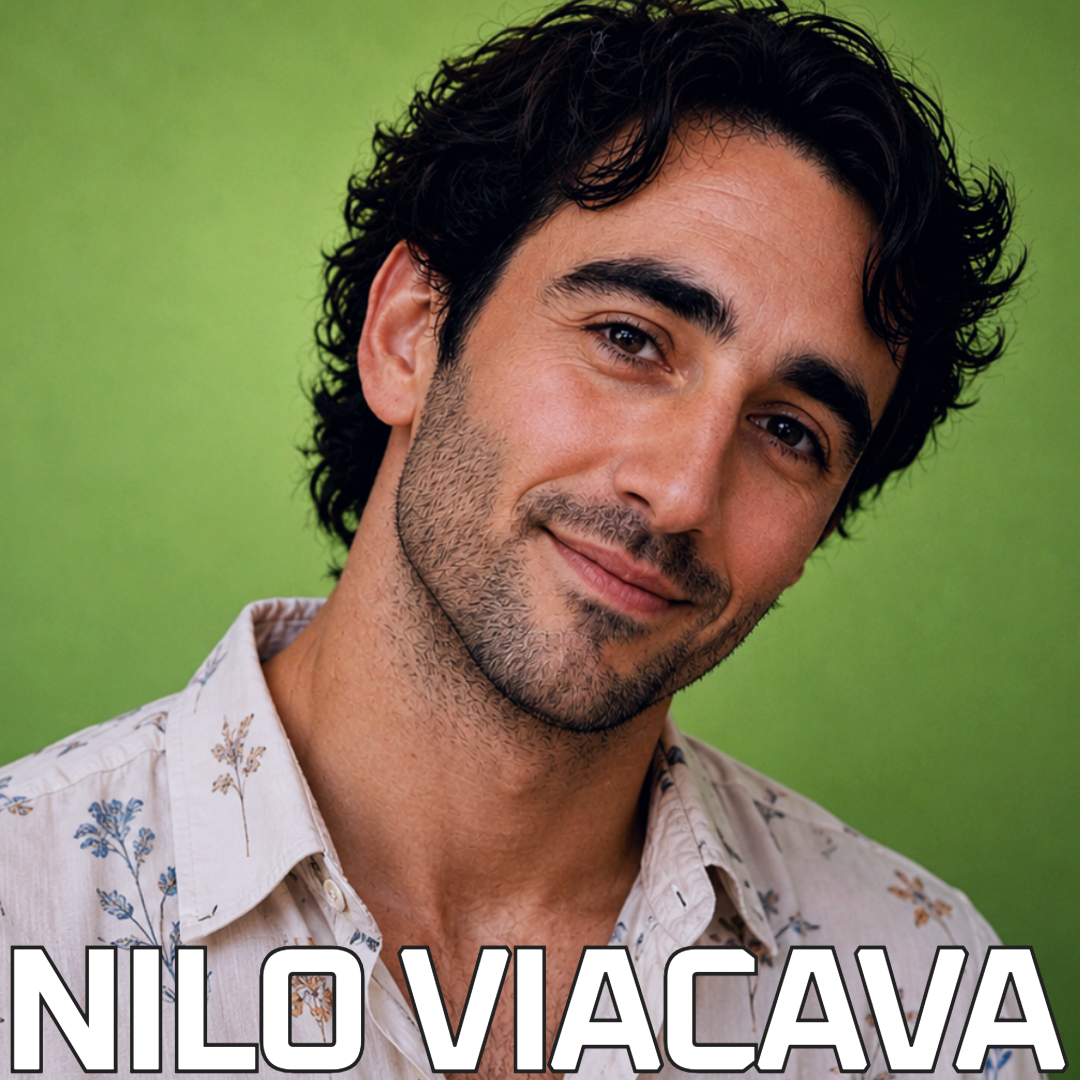
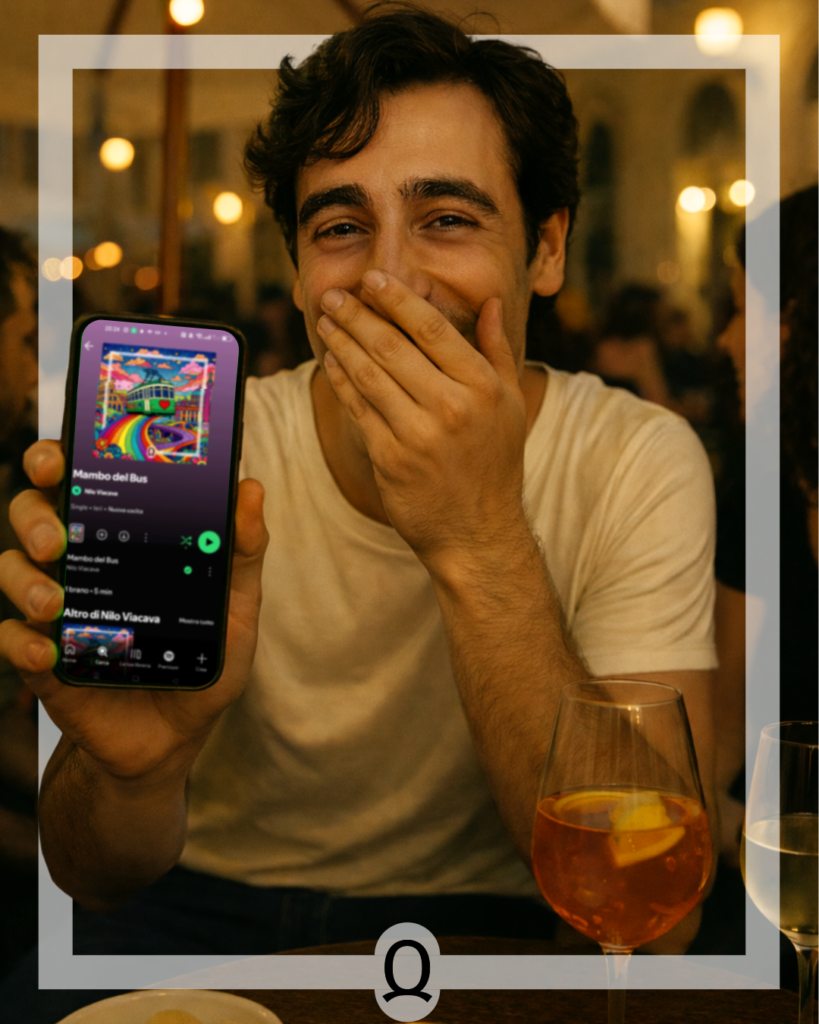
The Italo-Argentine, Nilo —born Danilo Santiago Viacava— is the grandson of the "Xeneizes" citizens, which are the descendants of Genoese immigrants who settled in the early 1900s in La Boca, in Buenos Aires. He moved to Rome, in Italy, only as a young man. He writes songs like they were short movie of a neighborhood : a crowded bus, a bitter laugh at the end of a shift, or a romance that sparks at a bar and ends in a tango.
Nilo’s signature lies in his storytelling. He knows how to twist the most ordinary matters into urban fairytales —sometimes grotesque, other romantic— depending on whether Nilo wants to make you laugh, cry, fall in love, reflect, or perhaps all of them! Waiting rooms, shared apartments, job hunting: settings and circumstances as harmless as they are common, but Nilo draws out details of the very humanity he loves to narrate. He speaks of messy romances and hard-earned achievements, of local news and personal experiences, of global issues and the surrealism that can save our world, of the ridicule hidden here and there, and the flaws that make us who we are. All without moralizing. Just a few brushstrokes, perhaps a gentle caricature, creating a vision that then stays with you.
Nilo, he never shouts what he has to say. He draws close, casual as he hums, and there isn't a single time he doesn't make you want to raise a glass and sing along with him. He is that kid from ths old fairytale, laughing out "The king is naked!"
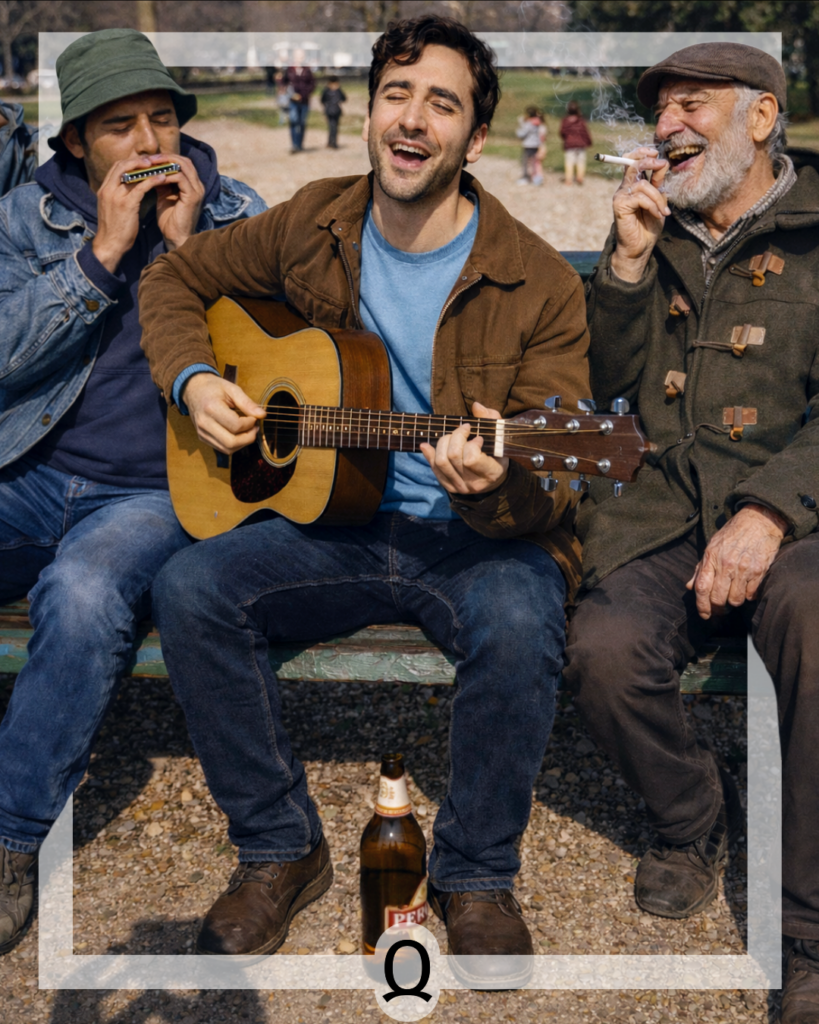






On stage, he brings his slightly Latin guitar —acoustic or electric, when needed— and an essential rhythm section: kick, snare, and hi-hat. At times, a pulsing cajón, rustling maracas, chimes and marimba, a washboard scratching out the tempo, or a vibraphone channeling folk-blues. Occasionally, Nilo also includes a brass section —either mariachi or Balkan— and at times his choruses swell into the popular warmth and comforting chaos of an actual marching band.
His sound sways between melodic pop songwriting and light-footed folk-rock, and It is infused with warm hints of bossa nova and samba for the sunny days, French chanson and bachata for the nostalgic moments, jazz manouche and Italian-style mambo when life pushes forward, or modern cumbia when the rhythm becomes necessary. Yet, everything is always filtered through a dry, ironic Roman attitude, reminiscent of a traditional Roman stornellatore (a tavern bard, a street singer) who never complains, yet is witty and sharp.
His Italian is colloquial, with a subtle Roman inflection and a Hispanic soul that occasionally shines through with lines and words in Spanish. Nilo is direct, yet elegant. And every now and then, he is deliberately eccentric, but just enough to open a window into the imagination of anyone who agrees to travel with him and to listen to his stories.
His voice is warm and feels confident. and is tone is comforting, and just slightly nasal. His narrative style ranges between a storytelling and a confession —though when necessary, it explodes into choruses that embrace and into rhythm that sweep the troubles away.
Well-told stories, free from any false rhetoric and stereotype, or else entirely built on such clichés only to make fun of our society and the absurdity of our world. His lyrics, balancing between fairytale and parody, ballads and anthems certainly won't change this world, but they can help make your day just a little better!
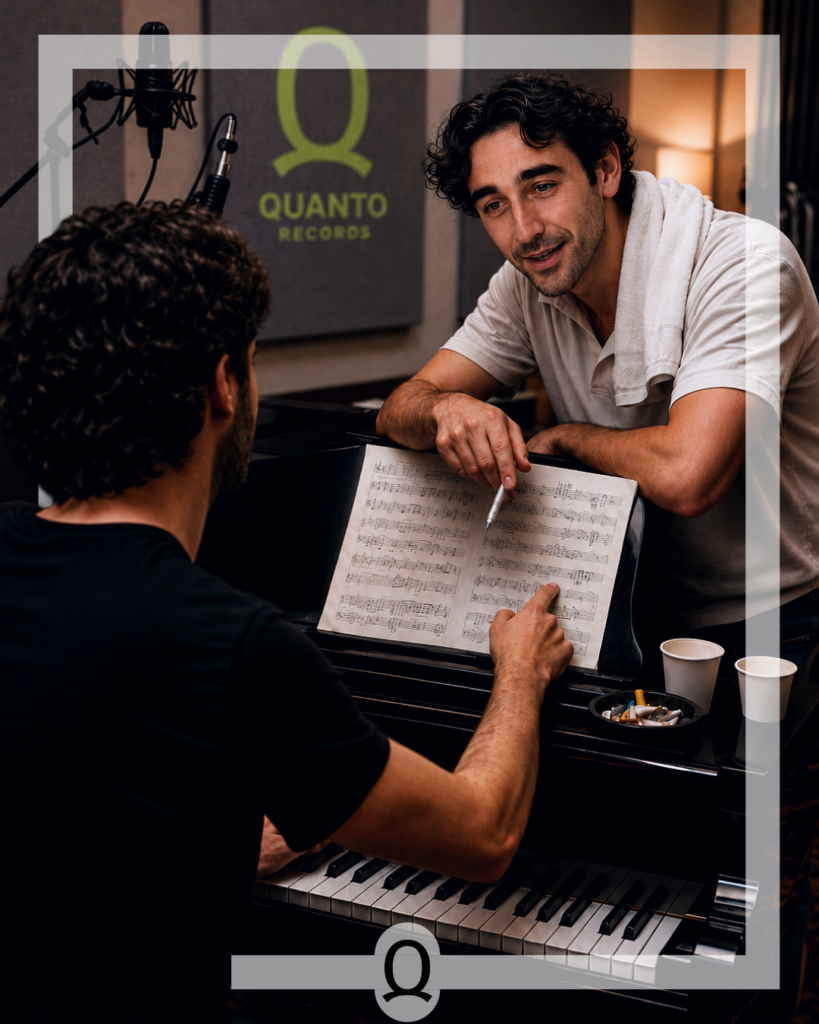
Between May and June 2026, Nilo traveled to Baires after many months of being unable to visit his family there, in Argentina. And then, recharged by the warmth and the soundscape of his barrio, he has returned to Rome to lock himself in QUANTO's recording studio and finalize the remaining songs of his debut album. His music gets your feet moving and adds a touch of spice to the flavor of life. Nilo himself... is a story that tells stories.
The Italo-Argentine, Nilo —born Danilo Santiago Viacava— is the grandson of the "Xeneizes" citizens, which are the descendants of Genoese immigrants who settled in the early 1900s in La Boca, in Buenos Aires. He moved to Rome, in Italy, only as a young man. He writes songs like they were short movie of a neighborhood : a crowded bus, a bitter laugh at the end of a shift, or a romance that sparks at a bar and ends in a tango.
Nilo’s signature lies in his storytelling. He knows how to twist the most ordinary matters into urban fairytales —sometimes grotesque, other romantic— depending on whether Nilo wants to make you laugh, cry, fall in love, reflect, or perhaps all of them! Waiting rooms, shared apartments, job hunting: settings and circumstances as harmless as they are common, but Nilo draws out details of the very humanity he loves to narrate. He speaks of messy romances and hard-earned achievements, of local news and personal experiences, of global issues and the surrealism that can save our world, of the ridicule hidden here and there, and the flaws that make us who we are. All without moralizing. Just a few brushstrokes, perhaps a gentle caricature, creating a vision that then stays with you.
Nilo, he never shouts what he has to say. He draws close, casual as he hums, and there isn't a single time he doesn't make you want to raise a glass and sing along with him. He is that kid from ths old fairytale, laughing out "The king is naked!"
On stage, he brings his slightly Latin guitar —acoustic or electric, when needed— and an essential rhythm section: kick, snare, and hi-hat. At times, a pulsing cajón, rustling maracas, chimes and marimba, a washboard scratching out the tempo, or a vibraphone channeling folk-blues. Occasionally, Nilo also includes a brass section —either mariachi or Balkan— and at times his choruses swell into the popular warmth and comforting chaos of an actual marching band.
His sound sways between melodic pop songwriting and light-footed folk-rock, and It is infused with warm hints of bossa nova and samba for the sunny days, French chanson and bachata for the nostalgic moments, jazz manouche and Italian-style mambo when life pushes forward, or modern cumbia when the rhythm becomes necessary. Yet, everything is always filtered through a dry, ironic Roman attitude, reminiscent of a traditional Roman stornellatore (a tavern bard, a street singer) who never complains, yet is witty and sharp.
His Italian is colloquial, with a subtle Roman inflection and a Hispanic soul that occasionally shines through with lines and words in Spanish. Nilo is direct, yet elegant. And every now and then, he is deliberately eccentric, but just enough to open a window into the imagination of anyone who agrees to travel with him and to listen to his stories.
His voice is warm and feels confident. and is tone is comforting, and just slightly nasal. His narrative style ranges between a storytelling and a confession —though when necessary, it explodes into choruses that embrace and into rhythm that sweep the troubles away.
Well-told stories, free from any false rhetoric and stereotype, or else entirely built on such clichés only to make fun of our society and the absurdity of our world.
His lyrics, balancing between fairytale and parody, ballads and anthems certainly won't change this world, but they can help make your day just a little better!
Between May and June 2026, Nilo traveled to Baires after many months of being unable to visit his family there, in Argentina. And then, recharged by the warmth and the soundscape of his barrio, he has returned to Rome to lock himself in QUANTO's recording studio and finalize the remaining songs of his debut album. His music gets your feet moving and adds a touch of spice to the flavor of life. Nilo himself... is a story that tells stories.